· Saunaline
Custom sauna or ready-made cabin: an honest comparison
When a prefabricated sauna is the right call, when made-to-measure is worth it, and how to recognise an adapted module sold as custom. A manufacturer's honest comparison.
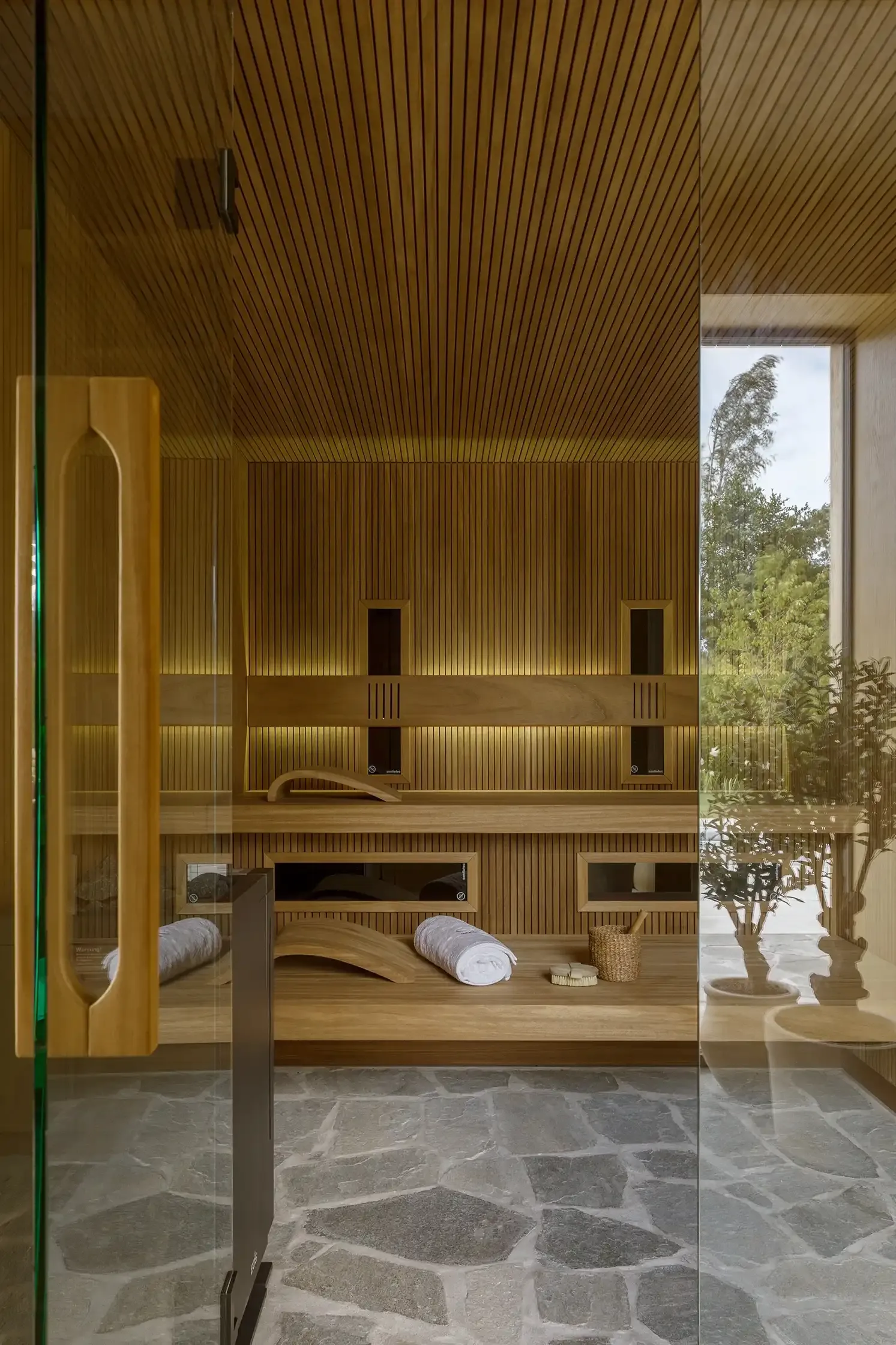
Both are legitimate products, and the honest answer depends on three things: the room, the budget, and how long you intend to look at the result. A ready-made cabin is the right choice more often than a premium manufacturer likes to admit. A custom sauna is the right choice in exactly the situations where a ready-made one quietly fails. This comparison is written by a manufacturer of custom saunas, so read it knowing where we stand; we have tried to keep the scales honest anyway.
What is the actual difference?
A ready-made cabin is a standardised product: fixed dimensions, a set materials list, a stock heater, assembled from a kit in a day. A custom sauna is drawn for one specific room and built once, for that room, on a production floor. The difference is not “better wood” as a line item. It is who the starting point is: the catalogue, or your room.
Between the two sits a third category the market does not advertise: the adapted module sold as custom. Many offers described as made-to-measure are standard wall modules cut to fit, with the same benches, the same glass, the same stock heater as the catalogue product. It is not a scam; it is a reasonable mid-market product. It is simply not what the word “custom” implies, and it is priced as if it were.
The comparison, point by point
- Price. Ready-made: roughly 6,500 to 20,000 PLN (EUR 1,500 to 5,000) for a quality cabin. Adapted mid-market “custom”: 28,000 to 55,000 PLN. Made-to-measure from a premium manufacturer: from about 75,000 PLN (around EUR 17,500). These are different products at different prices, not the same product with different margins.
- Fit to the room. Ready-made requires the room to fit the cabin; leftover gaps get trimmed with filler strips. Made-to-measure starts from the room: sloped ceilings, tight plans and non-standard glazing are the brief, not a problem.
- Materials. Ready-made is almost always spruce or aspen. Made-to-measure lets you choose abachi, abachi thermo, Canadian hemlock or black locust veneer, and 10 mm tempered glass in optiwhite or antisol instead of 8 mm float.
- The heater. Kits ship with the heater that fits the price point. In a commission the heater is sized to the cabin volume; we fit EOS units with steam where the brief calls for it.
- Control. A dial thermostat versus a touch controller with Wi-Fi, scheduling and an eco mode. This gap is widening every year.
- Installation and service. A kit is assembled by you or a hired fitter; warranty claims route through a reseller. A commission is installed by the team that built it, and serviced by the same people afterwards.
- Time. A kit: days. A commission: eight to twelve weeks from approved drawings. If the deadline is next month, that answers the question by itself.
- After ten years. This is where the products diverge most. Joinery either holds at 90 °C or it opens; benches built like furniture still look deliberate a decade in. A sauna you see every day from the living room earns its price differently than one behind a basement door.
When is a ready-made cabin the better choice?
Often. If the total budget is under 30,000 PLN, buy a good prefabricated cabin and spend the difference on a better heater; a well-chosen kit from a reputable dealer will serve you honestly. The same applies when the room is a standard rectangle that happens to match catalogue dimensions, when the sauna goes into a rental or seasonal property, or when speed matters more than fit. Nothing about a kit is embarrassing. The mistake is not buying a kit; the mistake is paying custom prices for one.
When is made-to-measure worth the money?
When the room decides. If the sauna is part of the architecture, if an architect has drawn the interior around it, if the ceiling slopes or the glazing is non-standard, a catalogue cabin will always look like what it is: a box placed in a room. And when the horizon is long: the difference between spruce and abachi, between 8 mm float and 10 mm optiwhite, between a stock stove and a sized EOS heater, is invisible in year one and obvious in year ten. That is the work we do at Saunaline, which is why our projects start from 75,000 PLN: the price is the consequence of the build, and the full breakdown is in our cost guide.
How to recognise an adapted module sold as custom
Five questions expose it quickly. Who draws the design, and will you see dimensioned drawings before production? Whose production floor builds it, and can you visit? What exactly is the glass: thickness, tempering, brand? Whose controller runs it, and who services it in five years? And will the people who build it also install it? A manufacturer answers all five without hesitation. A reseller of modules answers the first two vaguely, and the price should reflect that.
Frequently asked questions
Is a custom sauna worth it over a ready-made one? If the budget is under 30,000 PLN or the room is standard, no: a good kit is the rational choice. If the sauna must belong to the architecture and last decades, yes: fit, materials and build quality are exactly what the extra money buys.
What does each option cost? Quality ready-made cabins run 6,500 to 20,000 PLN. Mid-market adapted builds run 28,000 to 55,000 PLN. Made-to-measure from a premium manufacturer starts around 75,000 PLN, complete with design, installation and service.
How long does each take? A kit can be running within days. A made-to-measure commission takes eight to twelve weeks from approved drawings to installation.
Can a ready-made cabin be upgraded later? Partially: the heater and controls can usually be improved. The dimensions, walls and glazing cannot, which is why the room-fit decision has to be made at the start.
If your room is the deciding factor, see how a commission works or ask us about your project; the completed projects show what the difference looks like in practice.